Osiris, Isis and Horus
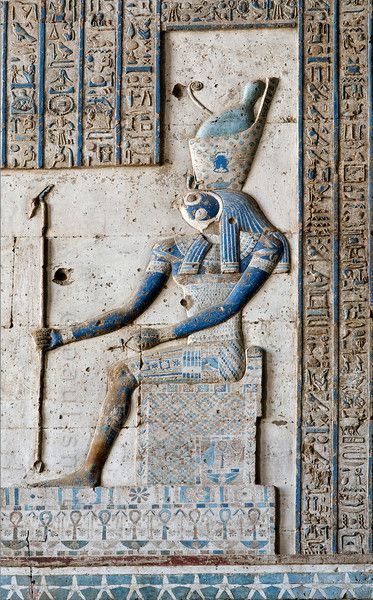
Source: Wikimedia Commons. CC BY-SA 4.0.
Horus, Temple of Hathor at Dendera
Osiris, Lord of the underworld, was originally a king of the earthly world, where he taught the Egyptians (and later the rest of the world) about life, religion, and the cultivation of grain (before his coming they had been cannibals). He was called Unnefer, or the "eternally good." He was murdered by his jealous brother Set, who tricked him into climbing into a wooden chest, which he then sealed and cast into the Nile. Isis, the wife of Osiris, recovered the body, but when Set found it again he cut it into many pieces and scattered the remains throughout Egypt. Stricken with grief, Isis and her sister Nephthys went about gathering the pieces one by one, and with the help of Anubis, guide of souls in the underworld, and of Thoth, scribe of the gods, they succeeded in reassembling Osiris, the first Mummy. Isis transformed herself into a kite and, flying over the body, breathed life into it with her wings; at that moment she conceived a son, Horus, who was destined to avenge his father. The resurrected Osiris returns to the darkness and desolation of the underworld to reign as lord and judge of the dead.
Isis and Osiris
This story, which deals with death and resurrection, reflects the cycles of the grain harvest and its regeneration from seeds; in Egyptian tombs small figurines of Osiris filled with grain seeds were placed as a pledge of rebirth.